FUROSCIX®(furosemide injection) with the On-Body Infusor is indicated for the treatment of edema (i.e., congestion, fluid overload, or hypervolemia) in pediatric patients who weigh at least 43 kg and adult patients with chronic heart failure or chronic kidney disease (CKD), including the nephrotic syndrome.
The On-Body Infusor is provided in a complete, ready-to-use kit. The Infusor itself is preprogrammed for treatment with a prefilled cartridge.

In an open-label, crossover study,
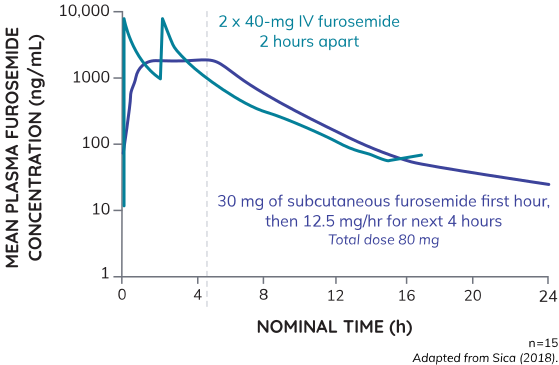
FUROSCIX AND IV FUROSEMIDE DEMONSTRATED EQUIVALENT BIOAVAILABILITY and diuresis1*
FUROSCIX Achieved 99.6% Absolute Bioavailability1
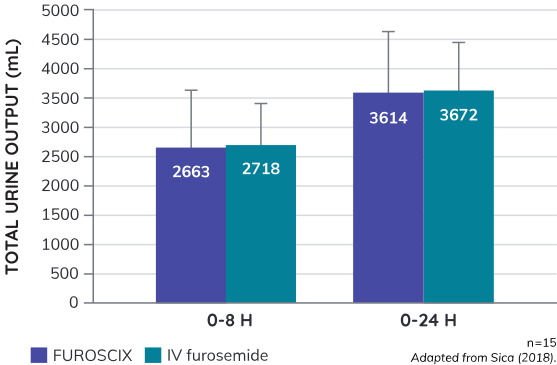
FUROSCIX DEMONSTRATED EQUIVALENT DIURESIS to IV1†
Phase 1, randomized, open-label, single-center crossover study in representative FUROSCIX patients characterizing the bioavailability, PK, and PD of FUROSCIX 80 mg/10 mL via the On-Body Infusor compared to the equivalent IV dose of furosemide. FUROSCIX demonstrated equivalent bioavailability.1
Urine output between FUROSCIX and IV furosemide remained consistent regardless of eGFR2
In patients with reduced eGFR, furosemide plasma levels increased as renal function declined2
Mean Cmax values from FUROSCIX were lower than IV2
*
90% confidence interval of 94.8-104.8. The design of the device used in this study was different from the current FUROSCIX On-Body Infusor, but it used the same administration profile.
†
Urine output over the periods of 0 to 8 hours and 0 to 24 hours following administration of 80-mg furosemide by 5-hour subcutaneous infusion with FUROSCIX, or IV administration of 2 doses of 40 mg 2 hours apart. Time 0 indicates the start of diuresis therapy.
Cmax=peak concentration.
Administration and dosing
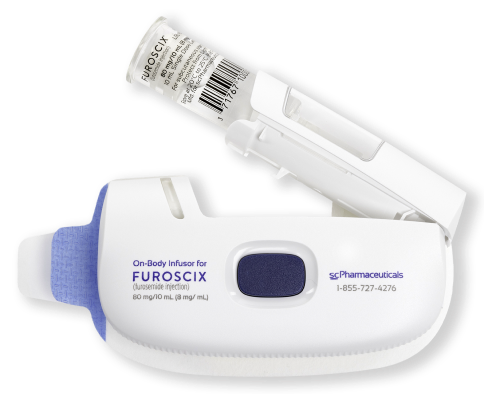
FUROSCIX delivers a fixed 80 mg of medication over 5 hours3:
- 30 mg in the first hour
- 12.5 mg per hour for the next 4 hours
The number of doses of FUROSCIX should be individualized based on the patient’s therapeutic response. FUROSCIX is not for chronic use and should be replaced with oral diuretics as soon as practical.
Any unused doses of FUROSCIX can be stored at room temperature. FUROSCIX for the On-Body Infusor has up to a 2-year shelf life.
tolerability and safety
The safety of subcutaneous FUROSCIX was established based on similar systemic exposure when compared to IV furosemide1
FUROSCIX for the On-Body Infusor is formulated with a pH of 7.4 to minimize tissue irritation1,3
Adverse reactions were consistent with those reported with IV furosemide3,4
The most common adverse reactions were erythema, bruising, edema, and infusion site pain3
monitoring
Monitoring is consistent with diuretic guidance and should be at the HCP’s discretion similarly to when oral diuretic regimens are augmented.5